The Real Faces of Mental Illness is a monthly interview series from real people sharing their personal stories and experiences. I want to show people what it’s really like to have a mental illness and not hide behind medical terms and symptoms. I want to share what it’s like to live with these diseases, on a day to day basis and how it really looks and feels and what recovery really involves. I want to share the real face of mental illnesses.
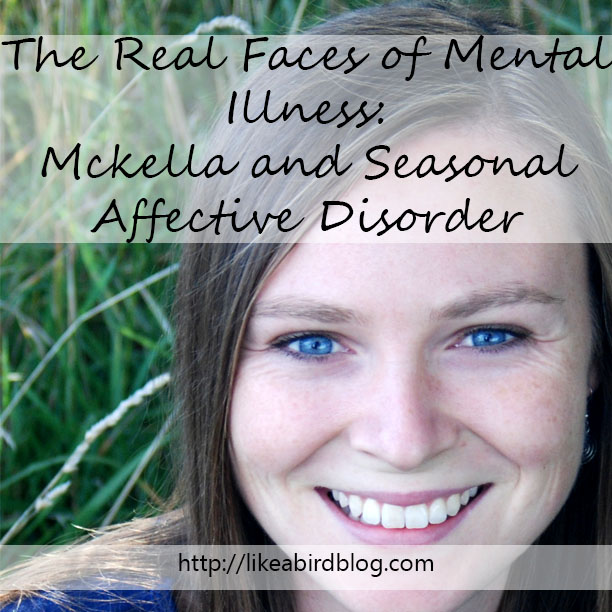
Can you tell us a bit about yourself? (name, age, job, hobbies etc)
My name’s McKella Sawyer and I’m in my mid-twenties. I’m a high school English tutor by day and an artist, writer, and soul explorer by night. I live in northern Utah with my husband, Sam and cat/studio assistant Louka. I love creating in any way, yoga, long walks, playing with animals, eating dark chocolate, and going on ridiculous adventures.
For those who don’t know, what is Seasonal Affective Disorder(SAD)?
Seasonal Affective Disorder, or SAD is a form of depression that typically occurs at a certain time of year, usually winter. The cause of this depression is often thought to be the lack of sunlight in the winter, though there are other factors as well.
What does SAD feel like for you?
At its worst, it feels like being trapped underwater without air, but not knowing that the reason you feel so awful is because you need air. You know you need something, that something very vital is missing, but you can’t put your finger on it. You start to think that maybe it’s just you, something wrong with you and that you shouldn’t feel so bad, but then suddenly you bob to the surface, fill your lungs, and feel better.
For the longest time even though I knew I got depressed in the winter, I’d forget that I’d feel better in the spring. When I feel so deprived of light, warmth, and that magical something in spring and summertime air, I thought it was because of some flaw of mine. I hate being cold and having to bundle up, not being able to feel the sun on my skin, and being trapped inside all the time because it’s dark and cold. Those things depress me just as sunshine, color, and fresh air invigorate me.
As far as the cycle of my symptoms go, I start to feel a decline in mood and energy in late August when I notice that the days are growing shorter. In the fall I this manic surge of energy along with intense anxiety and insomnia, then the depression and fatigue start in November and it’s all downhill until March or so. I feel better as the weather warms and the days lengthen.
What do you wish people knew about SAD?
There’s a common misconception that SAD and winter blues are same. While most people in temperate climates experience winter blues to some extent, SAD is far more severe and usually lasts longer. SAD symptoms tend to correlate with the light. I know I feel best in June when the days are longest, and I feel the most sluggish in December, though the depression part intensifies gradually until spring. And no, we can’t just “snap out of it”. It’s depression, just on a different schedule.
When did you first realize that you were struggling with SAD?
I didn’t know what it was until I was older, but I’ve had SAD since I was a child. As early as elementary school, I remember crying in the winter for no reason, getting bad grades during the winter term, and eating lots of sweets because I felt sad. I didn’t actually hear the term “Seasonal Affective Disorder” until I was in college and I thought “Yup, that’s me”. I was officially diagnosed at 20 years old when I first sought treatment, and then I started working with my current doctor last fall.
Have you been officially diagnosed by a doctor? If yes, what symptoms or events in your life led you to being tested? How has the official diagnoses affected your outlook on yourself, and your treatment?
I have been diagnosed, but it wasn’t a surprise or a shock at all. I knew long before I sought treatment, so it really hasn’t changed anything at all.
Have you sought treatment? Are you currently in therapy or on medication? How does that help your illness and day to day life?
I’ve tried the conventional route of medication and therapy but found it ineffective.
Right now I’m doing emotional work with my doctor/naturopath/emotional healing extraordinaire, Dr. Judith Moore. I take vitamins, use a lightbox in the morning and take melatonin at night, and have a walk outside every day. This helps keep my energy up and my sleep schedule on track so I’m not oversleeping and getting sluggish. My walks also give me a shot of endorphins and it’s important for me to get as much sunlight as possible.
I also do a ton of journalling and self-counseling to work through anxious or depressed thoughts. This is massively important because believing everything we think is why so many of us get sucked into depression and anxiety.
It’s working really well for me, and this past winter has been the best I can remember!
If you are currently on medication or have been in the past, what were they and what side effects did you encounter?
I took Celexa, an antidepressant, for awhile and found it gave me headaches, made me sleepy, and “flattened” me out. It dulled my creativity and emotional range, so I stopped taking it. I haven’t taken medication since and I hope I never need to. I see medication as a band-aid only to be used when one’s mental state is so compromised that they aren’t able to take other steps to improve their condition. Medication can provide a leg-up for a person to begin true healing, but I don’t think it’s a good long-term solution.
How has SAD affected your life? What routine event do you find you have the most trouble with? (example: day to day daily habits). How has it affected your relationships (with your family, your friends, your significant others)?
When I feel sad and fatigued, it’s all I can do to get to work and do our laundry. I’m not as motivated to eat well and do other things that ultimately help me feel better. I don’t feel as social in the winter and creativity doesn’t come as easily.
I’m lucky that my husband, friends, and family are supportive and don’t make a big deal out it. They know that this is how I am in the winter and that I’ll be more like myself later, and I know I can ask for help if I need anything. I got engaged to my husband in the winter and he’d never seen me like that, and I think it freaked him out! It’s just part of our lives now, and he knows what to expect and that it doesn’t last forever.
What are your personal triggers? How have you learned to deal with them?
A cold, dark, dreary day can mess me up. I might get really weepy and turn into a banana slug. If I feel that way and I can drag myself to work and back, I consider it a good day and I don’t expect myself to do much else. I know I’ll feel better when the sun comes out.
I also hate dealing with conflict, but especially in the winter. I just can’t handle it. Winter also isn’t a good time for me to learn new things because I get easily frustrated and overwhelmed. I tend to be much harder on myself when my symptoms are severe, and any mistake on my part usually invites all kinds of crappy self-talk, and then out comes the journal and I get to work undoing those thoughts.
What coping mechanisms have you tried and what has worked the best for you personally?
Movement and self-counseling help the most. Yoga gets me out of my head and into my body and smooths out any rough emotions. When I’m stuck in a cycle of negative thoughts, I bust out my notebook and do the self-counseling techniques I’ve learned from my doctor and other teachers. You have to learn to manage your thoughts and understand that they aren’t necessarily true. They’re just thoughts.
How do you define the word ‘wellness’? How do you focus on your personal wellness?
I think wellness is our natural state of health, energy, and joy. That doesn’t mean we’re happy and hyper all the time, it just means that we allow emotions to flow through us without fighting them and that our bodies function well.
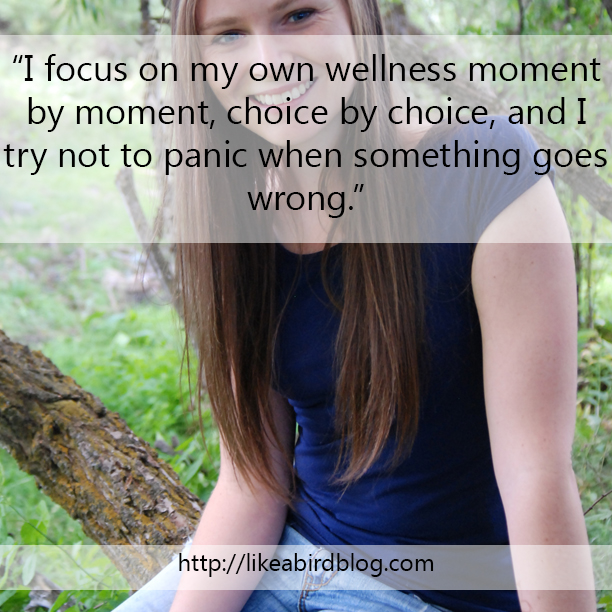
I focus on my own wellness moment by moment, choice by choice, and I try not to panic when something goes wrong. We make mistakes, and that’s ok. We oversleep sometimes, we eat things that don’t make us feel good, we wallow in a bad mood instead of allowing it to pass. You don’t have to be perfect, you just need to be aware that you have a choice and that’s all it takes to change something. All those tiny little choices add up.
That’s the best we can do, take it a moment at a time.
Have you experienced stigma or bullying? How do you deal with it?
I’ve never been bullied for SAD, but as a kid I usually gained weight in the winter from comfort eating, and goodness knows I took hell for that.
I think all mental illness carries stigma. People usually seem uncomfortable when I mention it. I don’t think a lot of people know what to think about it. They equate all mental illness with psycho killers in Stephen King novels and horror movies. They might think it’s dangerous or a personal flaw, no a condition as real and separate from their victims as physical diseases like diabetes or arthritis. They might consider mental illness “taboo”, something you shouldn’t discuss, especially with the person who has it.
What does your support structure look like? Do you have people in your life who are accepting and loving but don’t have a mental illness themselves and if so, how have they come to understand your illness?
I’m surrounded by lots of wonderful people, and no one else in my life has a mental illness. A lot of them don’t understand what it’s like to have one, and I don’t expect them to.
I know I can always ask for help if I need it. I have my husband, my parents and siblings, a best friend, awesome coworkers, an amazing doctor, my church, and plenty of animal friends to support me. I always have someone to talk to if I need to talk, someone to be with if I can’t stand being alone, and plenty of people to love me even when I’m a train wreck.
How has having SAD changed your perspective about life, creativity, love, etc?
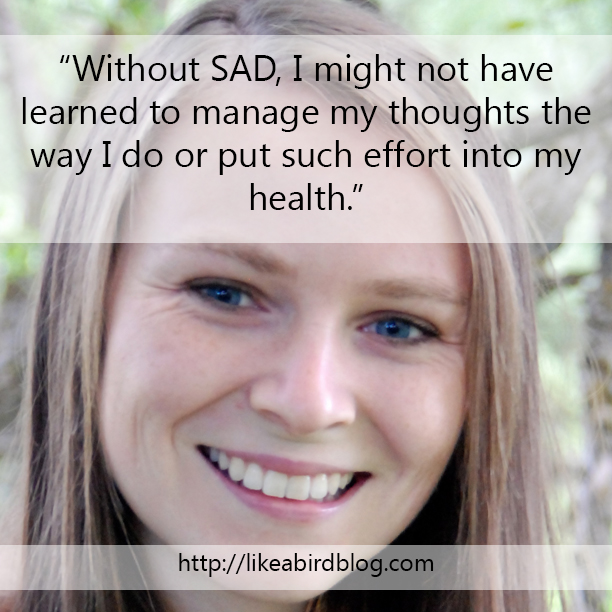
I know that challenges are ultimately for our highest good, and there’s something valuable here for me to learn. Without SAD, I might not have learned to manage my thoughts the way I do or put such effort into my health. Spring and summer probably wouldn’t seem so magical without the contrast of winter. I appreciate my creative bursts when I have them and I do my best to enjoy my need to rest and reflect. Life is meant to have contrast and sometimes it takes a mental illness to slow us down enough to realize that.
Do you do anything different in the months leading up to Fall/Winter to prepare yourself so you remain mentally stable?
I do whatever I can to make the rough months as easy as possible. I get a running start on my sleep schedule and movement habits so they’re easier to maintain when the light and weather get ugly. I also start using my lightbox as soon as I notice the light declining. I stock up on vitamins and melatonin, gather plenty of easy crockpot recipes or other meals I can assemble in ten minutes (the LAST thing I feel like doing when I’m depressed is cooking a healthy meal), organizing my space, and enjoying the last of the good weather. I also spend time in my journal and in meditation and work on making peace with this cycle. It’s easier to be at peace with it than to fight it.
What advice would you give to someone struggling with SAD?
First of all, understand that the SAD isn’t YOU. It’s something separate from you, something in your mind, but it isn’t you. When you’re stuck and feeling awful, think “this is the SAD talking, not me”. That will help you start to manage your thoughts.
Also, start preparing in the early fall or even late summer before your mood and energy start to decline. Make a habit of moving your body every day and being outside. Eat well, start taking any vitamins or supplements your doctor recommends, and make sure your sleep schedule is really solid. I can’t stress that last one enough. It’s so tempting to sleep way more than we need to in the winter, but if you’re in the habit of going to sleep and getting up at the same time, you’ve got a running start for a good winter.
What resources (books, websites, doctors etc) have been the most helpful in educating yourself about your own and other mental illnesses?
I learned about SAD from Dr. Norman E. Rosenthal’s book Winter Blues: Everything you Need to Know to Beat Seasonal Affective Disorder.
I also have plenty of resources to help me cope with the depression and anxiety of winter blues while it’s happening. Here are some of my favorites:
Dr. Judith Moore and her faith-based books: Healing from the Heart and Between Two Minds, which also has an accompanying workbook.
The work of Byron Katie is pure gold. I love her book, Loving What Is, and The Work is part of my regular self-counseling practice.
Louise Hay’s You Can Heal Your Life, a standard in any spiritual self-help library.
Dr. Daniel G. Amen’s books.
Christie Inge is an amazing teacher, and her work has been invaluable in helping me learn to feel my emotions and understand my unhealthy coping mechanisms. I’ve loved her work for years!
Do you believe it is it possible to ‘cure’ SAD? Do you think you can live a happy and fulfilling life even if you can’t ever be cured?
At best, it can be improved to the point that it could be considered “winter blues”. I don’t think SAD can be “cured” unless the person relocates to the tropics, though people with SAD can learn to function well and make peace with their condition. Sometimes that’s the best we can do…learn to have peace.
How do people react when you tell them/they find out you have SAD?
When I tell people I have SAD, they either react with sympathy, discomfort and changing the subject, or an “Oh, that sucks” brush-off. Again, many people consider mental illness to be taboo and aren’t comfortable discussing it.
What are the biggest misconceptions you’ve encountered when talking to people about SAD?
Most people seem to think it’s just winter blues, or that it’s just a couple short months or weeks in the winter. It may be that way for some people, but I experience symptoms as early as August and lasting until March or April. I even feel sad if we’ve had a few gloomy days in the middle of summer! Also, it isn’t always depression. Fatigue and anxiety are also factors, and I’ve noticed that in the fall I feel much more anxious than depressed.
Do you know anyone else with the same mental illness as yourself? If yes, how do you find your symptoms, experiences and treatments differ?
My grandmother gets depressed in the winter, though I don’t know if her condition is as severe as mine. She lives in southern California, so it’s hard to say. She’s never sought treatment as far as I know.
Do you use creativity in any form to improve your mental health?
I love to write and create art. Sometimes it’s harder to motivate myself to get into the studio in the winter, but once I do I feel amazing. It’s incredible how things work out in my unconscious while I create art, and I usually find the answer I was seeking in the finished piece.
I journal constantly and sometimes this turns into writing stories or bad poetry or just making random lists to combine ideas in a way I might not have thought of before. Sometimes, that’s the most creative I can be at the moment.
I love to enjoy the creations of others when I can’t muster up the energy to be creative myself. I listen to music, read a lot of books, and look at plenty of art. Sometimes this unsticks my creative momentum, and sometimes it doesn’t. Creativity is vital to wellness and mental health, so I make it a big part of my life, both by making and enjoying what others create.
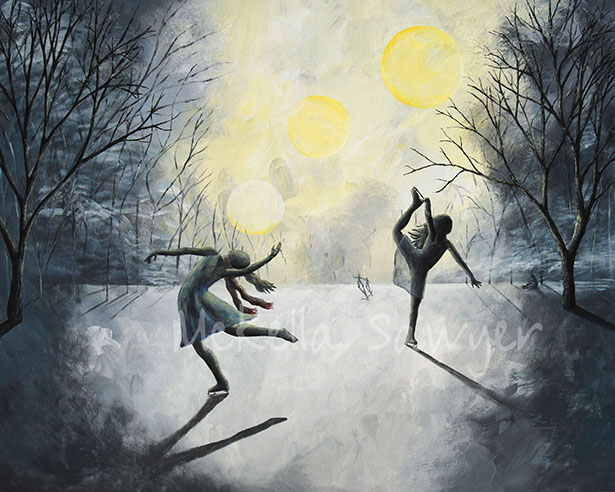
I created “Winter’s Light” during the winter of 2013 as a comfort I supposed, to assure myself that it is possible for me to be ok in the winter even if the best I can do is make peace with SAD. Even if I can’t get much done, I can still find joy. I’ll probably never love winter, but I can learn to appreciate it. I’m still working on that, but this painting marked the beginning of that effort.
Do you see having a mental illness as a curse or a gift? Or both? Why?
It’s challenging, but I think all challenges are gifts. They’re meant to teach us something important. It’s not fun, but I’ve grown so much in my efforts to cope with this illness, and I don’t think I’d be the same person without it.
About McKella:
McKella Sawyer is an artist, writer, and wisdom junkie from Utah. She’s a true creative spirit and has dabbled in theater, singing, piano, dancing, as well as all kinds of art such as drawing, painting, sculpture, collage, photography, and printmaking. She earned her bachelor’s degree in English creative writing with a minor in art from Weber State University and now primarily writes at her blog and website. McKella dreams of helping women live creative, thriving lives and is working on her very first e-course, which she plans to release this summer. Connect on facebook, twitter and instagram.

Thank you so much McKella for opening up and sharing your experiences with SAD. Hopefully, as winter comes to an end, this can help others if they’ve been feeling depressed this season and figure out how to cope next year.